A self-organizing team of AI agents, in an environment you control.
Start from a goal or an explicit task DAG. Route, approve, budget, trace, and resume at task boundaries—in your own environment.
captured goalcollapse
Review this service for security vulnerabilities and produce a triaged report. Evidence — a small Node.js/Express service: FILE: src/server.ts app.get('/admin/users', (req, res) => res.json(db.query("SELECT * FROM users WHERE name = '" + req.query.name + "'"))) FILE: .env.example ADMIN_API_KEY=[REDACTED generic-secret] Dependency manifest: express ^4.17.0; the start script runs src/server.js. Secret signal: .env.example:1 generic-secret. Complete four coordinated deliverables: 1. Review the attack surface: auth, exposed endpoints, and trust boundaries. 2. Review data security: injection, secret handling, and sensitive data. 3. Review the supply chain: dependencies, configuration, and deployment. 4. Synthesize a deduplicated, severity-ranked security report.
#4be5c70bAttack Surface Review3 more tasks · expand full DAG
From intent to a controlled, inspectable run.
Choose the topology, move ready work, put policy at the right boundaries, and keep the evidence.
Use runTeam() to generate a reviewable task DAG, or runTasks() to execute the graph you define. Explicit mode, governance, or an ExecutionRouter chooses single-agent or team execution.
runTeam · runTasks · mode · routingDecisionThe event-driven scheduler removes unrelated round barriers. Match tasks by capability, validate hard requirements, approve each ready dispatch, and preserve unmerged task results.
event-driven · onTaskDispatch · taskResultsDeclare roles and review paths, confirm consequential tools, bound further calls at turn and task boundaries, then inspect governance conclusions, receipts, traces, and evaluation gates.
governance · onToolCall · receipt · EvalSetUse cloud providers, a local endpoint, or an air-gapped deployment on your credentials. Tools are default-deny, and core has only three runtime dependencies.
offline · default-deny tools · 3 runtime depsInspect what happened after every run.
The offline Run Viewer turns a completed run into reviewable evidence, without sending it to a hosted OMA service.
- Task DAG and assignees
- Model, provider, token, and cost rollups
- Tool calls, status, and safe evidence details
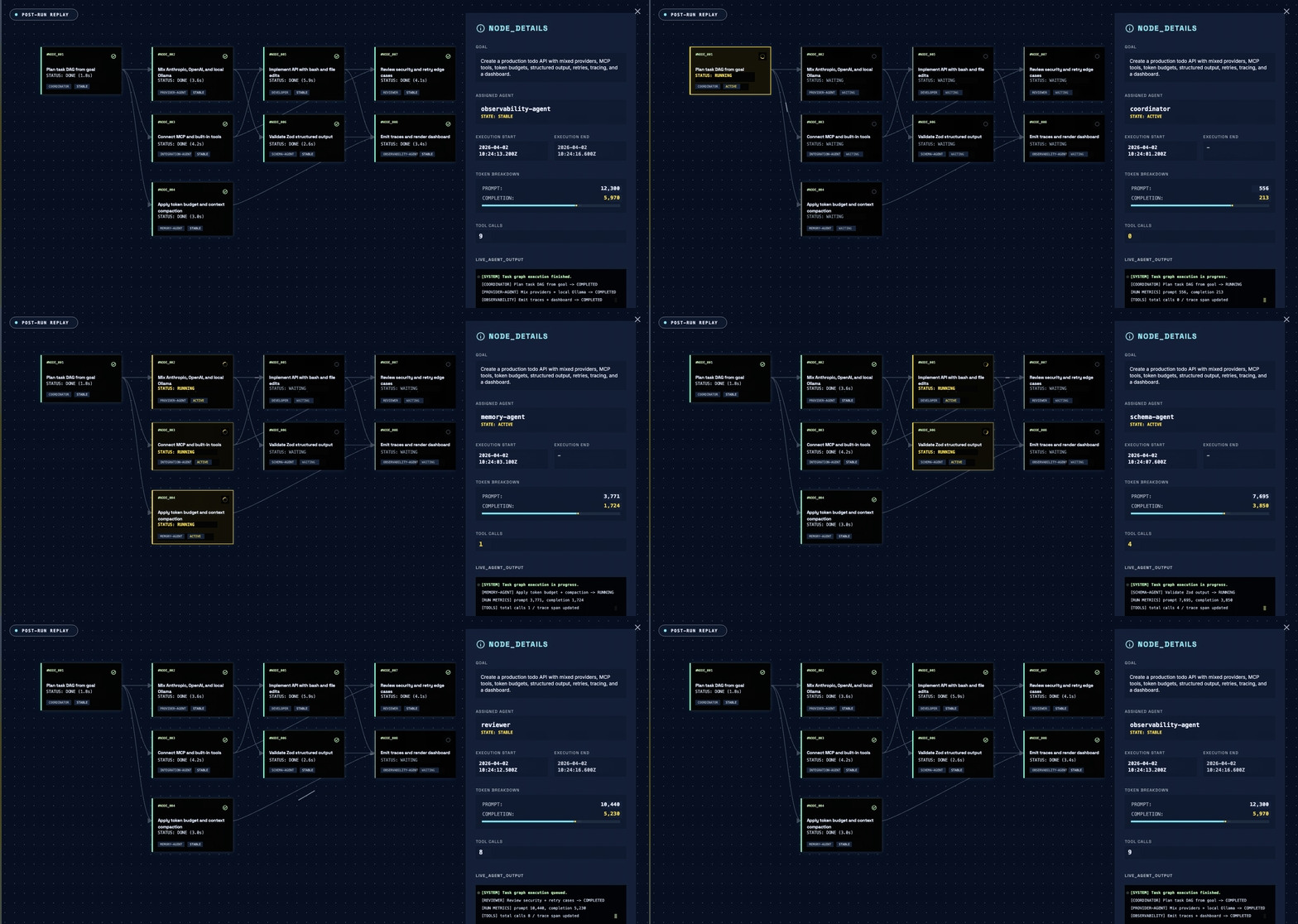
Three workflows, three explicit orchestration choices.
Start from the outcome you need, then open a runnable recipe with the orchestration choice made explicit.
goal-driven · runTeam()A coordinator selects the specialists needed for a shipping or billing escalation, then synthesizes their evidence.
explicit DAG · runTasks()Extract clauses once, run compliance and summary work in parallel, then wait for both before producing the notification.
explicit DAG · runTasks()Three fixture-backed investigations start in parallel, then feed a root-cause hypothesis and final postmortem.
Open source, live from the repo.
Repository signals and real projects, kept compact enough to verify without turning the homepage into a catalog.
WordPress security analysis platform. Runs OMA built-in tools (bash, file ops, grep) inside a Docker runtime.
AI pull-request review assistant. Runs an OMA review team — a coordinator plus scoped reviewer agents — with custom tools and token-aware diff compression.
Terminal AI coding assistant. Drives an OMA team through runAgent / runTasks / runTeam with a custom RunTeamOptions coordinator, paired with DeepSeek.
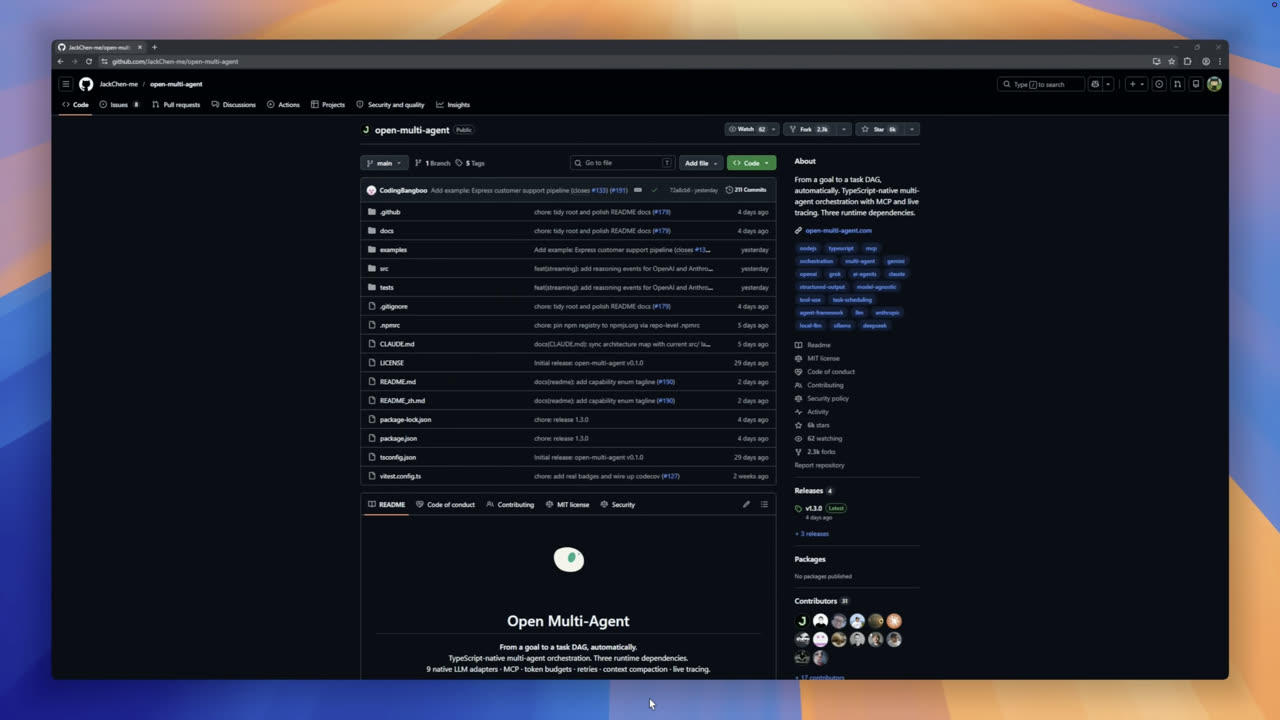
A brilliant TypeScript-native multi-agent orchestration framework.
How the TypeScript runtime behaves.
Straight answers to the questions that come up most. The full reference lives in the docs.